
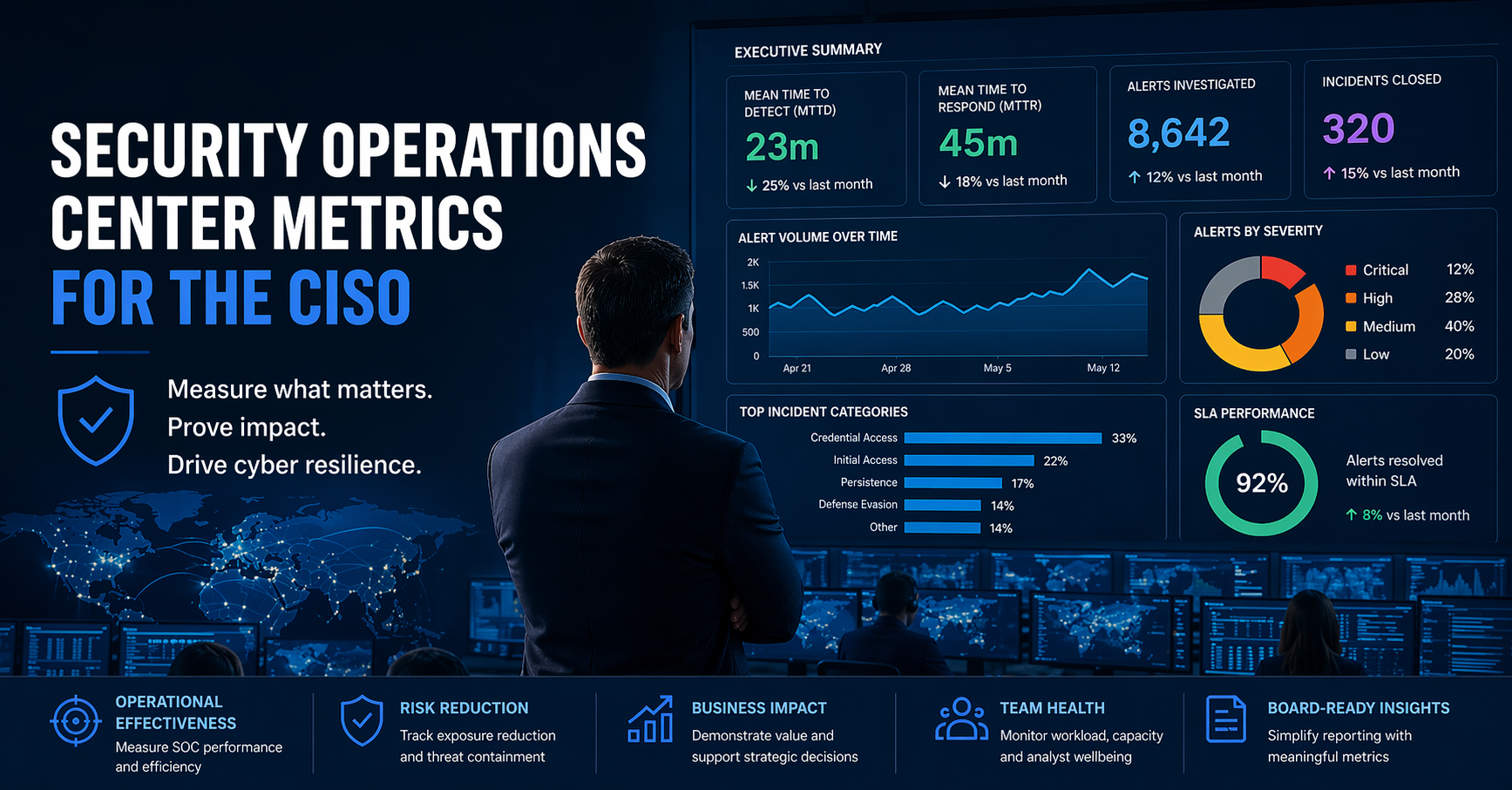
Security Operations Centers (SOCs) generate a constant stream of alerts, tickets, dashboards, and reports. But volume does not equal value. Many CISOs receive weekly metrics that look impressive on paper - thousands of alerts processed, hundreds of incidents closed, dozens of detections created - yet still struggle to answer one critical question: Is the SOC actually reducing cyber risk?
The most effective SOC metrics are not vanity numbers. They are indicators of operational performance, resilience, and business protection. They help security leaders justify investment, identify bottlenecks, improve analyst performance, and communicate security posture to executives.
Below are five of the most important SOC metrics every CISO should track, why they matter, and how to use them strategically.
1. Mean Time to Detect (MTTD)
What It Measures:
The average time it takes to identify malicious activity after it begins.
Why It Matters:
The faster threats are detected, the less time attackers have to move laterally, escalate privileges, exfiltrate data, or deploy ransomware. Detection speed often determines whether an incident becomes a minor disruption or a major breach.
Formula:
MTTD = Total Time to Detect Incidents / Number of Incidents
Example:
If five incidents took a total of 10 hours to detect:
MTTD = 10 / 5 = 2 hours
Executive Insight:
A declining MTTD usually indicates stronger detections, better visibility, and more mature monitoring.
Improvement Actions:
- Tune SIEM detections
- Improve log coverage
- Deploy endpoint telemetry
- Use AI-assisted alert triage
- Conduct threat hunting
2. Mean Time to Respond (MTTR)
What It Measures:
The average time it takes to contain, remediate, and recover from an incident after detection.
Why It Matters:
Fast detection without fast response still leaves the organization exposed. MTTR reflects how quickly the SOC and incident response teams can neutralize threats.
Formula:
MTTR = Total Response Time / Number of Incidents
Example:
If four incidents require a combined 16 hours to contain:
MTTR = 16 / 4 = 4 hours
Executive Insight:
A strong SOC minimizes attacker dwell time and business disruption.
Improvement Actions:
- Use SOAR automation
- Pre-stage containment playbooks
- Improve communication workflows
- Define escalation paths
- Practice tabletop exercises
3. Alert Fidelity (True Positive Rate)
What It Measures:
The percentage of alerts that are legitimate threats rather than false positives.
Why It Matters:
Too many false positives create alert fatigue, analyst burnout, and missed real threats. High alert fidelity means the SOC spends time investigating meaningful activity.
Formula:
True Positive Rate = Valid Security Alerts / Total Alerts Investigated
Example:
If analysts review 1,000 alerts and 150 are genuine threats:
15% fidelity
Executive Insight:
More alerts does not mean better security. Better alerts do.
Improvement Actions:
- Tune detection rules
- Eliminate duplicate alerts
- Use threat intelligence enrichment
- Apply behavior analytics
- Continuously review noisy detections
4. Incident Volume by Severity
What It Measures:
The number of incidents categorized by criticality (Critical, High, Medium, Low).
Why It Matters:
This metric shows the organization’s real threat landscape. A rising number of low-severity events may be manageable. A spike in critical incidents may indicate control failure, active targeting, or environmental weakness.
Example Monthly Snapshot:
- Critical: 2
- High: 8
- Medium: 37
- Low: 95
Executive Insight:
Severity trends are more valuable than raw totals. They help CISOs prioritize resources and communicate risk trends to leadership.
Improvement Actions:
- Refine severity classifications
- Correlate incidents to business assets
- Track repeat incident categories
- Align reporting with enterprise risk register
5. Analyst Utilization and Case Closure Efficiency
What It Measures:
How effectively analysts are managing workload, resolving cases, and using time.
Why It Matters:
Technology does not run a SOC—people do. Burned-out analysts, overloaded queues, and slow case closure create operational risk. This metric reveals staffing stress before turnover or missed threats occur.
Useful Indicators:
- Cases handled per analyst
- Average case closure time
- Queue backlog
- Escalation rates
- After-hours workload
Executive Insight:
A SOC operating at unsustainable capacity will eventually fail.
Improvement Actions:
- Balance staffing across shifts
- Automate repetitive tasks
- Improve runbooks
- Reduce low-value alerts
- Crosstrain analysts
Metrics CISOs Should Avoid Overvaluing
Some common metrics look useful but often mislead:
Number of Alerts Processed
High numbers may simply reflect poor tuning.
Number of Tickets Closed
Closing tickets quickly does not always equal effective investigation.
Tool Count
Owning more tools does not guarantee better outcomes.
Dashboard Activity
Busy dashboards can mask operational inefficiency.
How to Present SOC Metrics to Executives
Executives care about risk, resilience, and business impact. Convert technical metrics into business language.
Instead of saying:
- MTTD improved from 6 hours to 2 hours
Say:
- We reduced attacker dwell time by 67%, lowering potential of breach impact.
Instead of saying:
- False positives dropped by 40%
Say:
- Analysts recovered capacity to focus on real threats and faster investigations.
Recommended SOC Dashboard for CISOs
A strong monthly CISO dashboard should include:
- MTTD trend (90 days)
- MTTR trend (90 days)
- Critical incidents by month
- Alert fidelity percentage
- Analyst backlog and workload health
- Major incidents with business impact summary
Final Thoughts
The best SOC metrics do more than measure activity. They measure readiness, speed, efficiency, and risk reduction.
Every CISO should know:
- How quickly threats are detected
- How quickly incidents are contained
- Whether alerts are trustworthy
- Whether critical incidents are rising
- Whether the team can sustain operations
If your metrics cannot guide decisions, justify investment, or reduce risk, they are noise.
A mature SOC is not defined by how many alerts it sees. It is defined by how effectively it turns data into defense.
Summary
The five SOC metrics every CISO should track are:
- Mean Time to Detect (MTTD)
- Mean Time to Respond (MTTR)
- Alert Fidelity
- Incident Volume by Severity
- Analyst Utilization & Closure Efficiency
Together, these metrics provide a balanced view of technology performance, threat exposure, and human capability. This is what executive security leadership needs.
Phelix Oluoch
Founder, PhelixCyber
W: PhelixCyber.com
