
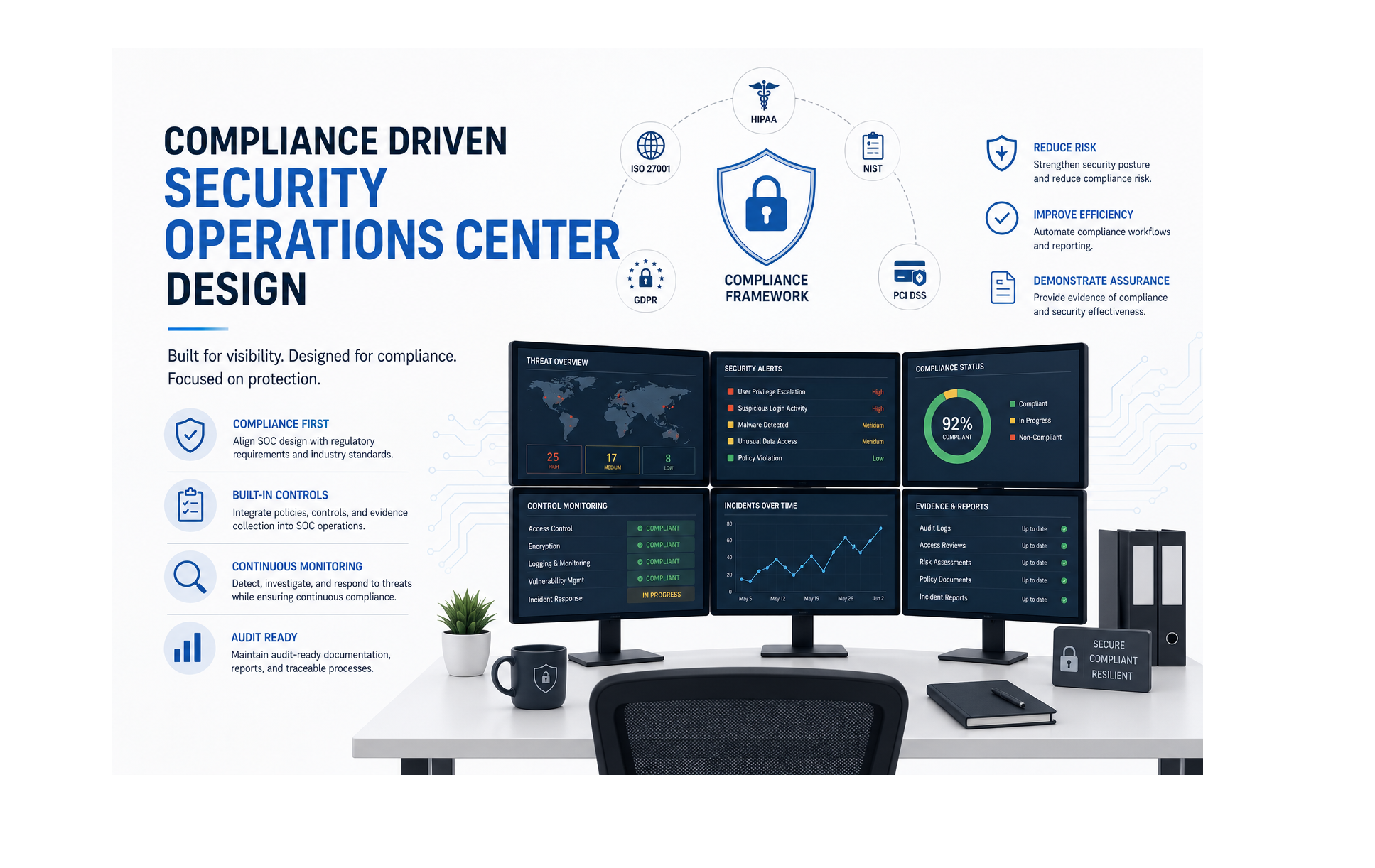
Compliance is often treated as something that happens after security operations are designed.
An organization deploys a SIEM, EDR, vulnerability management platform, and incident response process. Then, when an audit approaches, the security team attempts to map those capabilities to regulatory requirements.
This approach creates unnecessary work and often produces weak evidence.
A better strategy is compliance-driven SOC design: using regulatory, contractual, and security-control requirements as architectural inputs when designing the Security Operations Center.
A compliance-driven SOC is not simply a SOC that generates audit reports. It is a security operations capability designed to continuously collect the telemetry, detect the threats, respond to incidents, and retain the evidence required to demonstrate that security controls are operating effectively.
The objective is to build a SOC where security operations and compliance reinforce each other.
What Is a Compliance-Driven SOC?
A compliance-driven SOC is a security operations capability designed around three interconnected objectives:
- Detect and respond to threats
- Implement and monitor required security controls
- Produce reliable evidence demonstrating control effectiveness
This creates a continuous operating model:
Requirements → Controls → Telemetry → Detection → Response → Evidence → Assurance
For example, a requirement may mandate monitoring of privileged activity.
That requirement should translate into:
- A defined security control
- Appropriate identity and endpoint telemetry
- Detection rules
- Alert triage procedures
- Incident response workflows
- Log retention requirements
- Evidence demonstrating that monitoring is operational
This is fundamentally different from simply documenting that a control exists.
Compliance Should Influence SOC Architecture
Different regulatory and contractual frameworks impose different requirements.
Examples include:
- PCI DSS
- HIPAA Security Rule
- SOX
- NIST Cybersecurity Framework
- NIST SP 800-53
- ISO/IEC 27001
- CMMC
- FedRAMP
- GDPR
- State privacy regulations
- Customer-specific security requirements
The specific requirements vary, but many frameworks address common security capabilities:
- Logging and monitoring
- Access control
- Privileged access
- Vulnerability management
- Incident response
- Configuration management
- Network security
- Data protection
- Audit trails
- Security testing
The SOC becomes the operational layer that continuously monitors many of these controls.
The Compliance-to-Detection Pipeline
A useful way to design a compliance-driven SOC is to establish traceability between a requirement and the detection capability supporting it.
Consider the following chain:
Compliance Requirement
↓
Security Control
↓
Threat Scenario
↓
Data Source
↓
Detection Logic
↓
SOC Alert
↓
Response Procedure
↓
Evidence
This model creates accountability across the entire detection lifecycle.
For example:
|
Layer |
Example |
|
Requirement |
Monitor privileged activity |
|
Control |
Privileged account monitoring |
|
Threat |
Unauthorized privilege use |
|
Telemetry |
Identity provider + endpoint logs |
|
Detection |
Suspicious privileged authentication |
|
Alert |
High-severity SOC alert |
|
Response |
Investigate and contain |
|
Evidence |
Alert, investigation, and response records |
This traceability is one of the most important characteristics of a mature compliance-driven SOC.
Step 1: Identify Applicable Requirements
The first step is determining which compliance and contractual obligations apply to the organization.
Do not begin by purchasing security technology.
Begin by understanding the requirements.
Create a compliance requirements inventory containing:
- Framework
- Requirement
- Control
- Applicable systems
- Data sources
- Detection requirements
- Response requirements
- Evidence requirements
- Control owner
For example:
|
Requirement Area |
SOC Implication |
|
Logging |
Centralized log collection |
|
Monitoring |
SIEM/analytics capability |
|
Access Control |
Identity telemetry |
|
Privileged Access |
PAM and administrative monitoring |
|
Incident Response |
SOC playbooks |
|
Vulnerability Management |
Vulnerability telemetry |
|
Audit Trails |
Immutable log retention |
|
Security Testing |
Detection validation |
This becomes the foundation of the SOC architecture.
Step 2: Build a Control-to-Detection Matrix
A compliance requirement should not automatically become a detection rule.
Instead, determine what security control is required and then identify how the SOC supports that control.
A control-to-detection matrix can look like:
|
Control |
Threat |
Telemetry |
Detection |
Response |
|
Privileged access monitoring |
Account abuse |
IAM logs |
Abnormal admin activity |
Investigate |
|
Audit logging |
Log tampering |
SIEM logs |
Logging disabled |
Escalate |
|
Endpoint protection |
Malware |
EDR |
Malicious execution |
Isolate |
|
Network monitoring |
C2 |
DNS/NetFlow |
Suspicious communication |
Block |
|
Account management |
Account compromise |
IAM |
Impossible travel |
Disable account |
This creates a direct relationship between compliance requirements and SOC operations.
Step 3: Design the Telemetry Architecture
Compliance-driven SOC design is heavily dependent on telemetry.
A detection cannot exist without the necessary data.
Common data sources include:
Identity
- Active Directory
- Entra ID
- Okta
- Privileged Access Management systems
- Authentication platforms
Endpoint
- EDR/XDR
- Windows Event Logs
- Sysmon
- Linux audit logs
- macOS telemetry
Network
- Firewalls
- DNS
- Proxy
- VPN
- IDS/IPS
- NetFlow
Cloud
- AWS CloudTrail
- Azure Activity Logs
- Microsoft Entra logs
- Google Cloud audit logs
- Kubernetes audit logs
Applications
- Database logs
- Web application logs
- Authentication logs
- API activity
Security Infrastructure
- Vulnerability scanners
- Email security
- DLP
- CASB
- Security gateways
The objective is not to collect every possible log.
The objective is to collect the telemetry necessary to support risk, detection, investigation, and compliance objectives.
Step 4: Define Logging and Retention Requirements
Logging architecture is particularly important in regulated environments.
Organizations need to answer questions such as:
- What events must be logged?
- Where are logs stored?
- How long are they retained?
- Who can access them?
- Are logs protected from modification?
- Can investigators search historical activity?
- Are timestamps synchronized?
- Is log collection monitored?
A mature architecture should also detect failures in the logging pipeline.
For example:
If a critical server stops sending security logs to the SIEM, the SOC should know.
This is an often-overlooked detection use case.
The SOC should monitor not only security events but also the health of the telemetry itself.
Step 5: Align Detection Engineering With Compliance
Compliance requirements should inform detection engineering priorities.
For example, if an organization must monitor privileged access, detection engineers can develop detections for:
- Privileged account creation
- Privilege escalation
- Administrative logins
- Authentication anomalies
- Privileged access outside normal hours
- Privileged access from unusual locations
- Changes to privileged groups
- Disabled security controls
These detections can then be mapped to frameworks such as MITRE ATT&CK where appropriate.
This creates two complementary views:
Compliance perspective:
Are required security controls operating?
Threat perspective:
Can we detect adversary behaviors targeting those controls?
The strongest SOCs use both.
Step 6: Implement Continuous Control Monitoring
Traditional compliance programs often rely on periodic assessments.
A SOC can move toward continuous control monitoring.
Instead of asking once a year:
"Are security logs being collected?"
the SOC can continuously monitor:
- Log source availability
- Endpoint coverage
- EDR health
- Authentication logging
- Privileged account activity
- Security control changes
- Vulnerability exposure
- Detection health
This turns compliance from a periodic exercise into an operational capability.
Step 7: Integrate Incident Response With Compliance
Incident response should be designed with regulatory obligations in mind.
SOC workflows should identify:
- What constitutes a security incident
- Who must be notified
- What evidence must be preserved
- Who owns escalation
- What timelines apply
- What documentation is required
- What legal or privacy teams need to be involved
A SOC playbook should therefore contain more than technical containment steps.
A mature workflow might look like:
Alert
↓
Triage
↓
Incident Classification
↓
Containment
↓
Evidence Preservation
↓
Regulatory Assessment
↓
Notification Decision
↓
Recovery
↓
Lessons Learned
This ensures compliance requirements are integrated into operational response rather than handled as an afterthought.
Step 8: Build an Evidence Architecture
One of the most important differences between security monitoring and compliance-driven security operations is evidence.
A SOC should be able to demonstrate:
- What happened
- When it happened
- What was detected
- Who investigated it
- What actions were taken
- When actions were taken
- What evidence supported the decision
- Whether the incident was resolved
Evidence can include:
- SIEM events
- EDR telemetry
- Alert records
- Case management records
- Investigation notes
- Analyst actions
- Ticket history
- Configuration records
- Vulnerability reports
- Detection test results
Evidence should be protected from unauthorized modification and retained according to applicable requirements.
Step 9: Measure SOC Compliance Effectiveness
Traditional SOC metrics such as MTTD and MTTR remain important, but compliance-driven SOCs need additional measurements.
Control Coverage: What percentage of required controls are supported by operational monitoring?
Telemetry Coverage: What percentage of in-scope assets provide required security telemetry?
Detection Coverage: What percentage of high-risk threat scenarios have validated detections?
Evidence Completeness: Can the SOC produce sufficient evidence to demonstrate control operation?
Control Failure Detection: How quickly can the SOC identify when a security control stops functioning?
Detection Validation: What percentage of critical detections have been tested recently?
These metrics provide a much more meaningful picture of security and compliance maturity.
A Reference Compliance-Driven SOC Architecture
A simplified architecture can be structured into six layers.
Layer 1 — Assets
Endpoints, servers, applications, cloud resources, identities, and network infrastructure.
Layer 2 — Telemetry
Logs, events, network data, EDR telemetry, cloud audit records, and identity activity.
Layer 3 — Security Analytics
SIEM, XDR, UEBA, threat intelligence, behavioral analytics, and correlation.
Layer 4 — Detection Engineering
ATT&CK-aligned rules, compliance-driven detections, behavioral analytics, and correlation logic.
Layer 5 — SOC Operations
Triage, investigation, threat hunting, incident response, automation, and escalation.
Layer 6 — Governance & Assurance
Compliance mapping, evidence collection, control monitoring, reporting, risk management, and continuous improvement.
The key is that governance should not sit completely outside the SOC.
It should be connected to operational security data.
Common Mistakes in Compliance-Driven SOC Design
1. Designing the SOC Around the Audit
A SOC should not exist primarily to pass an audit.
Compliance should inform the architecture, but security risk should remain the primary driver.
2. Collecting Logs Without a Purpose
More telemetry does not automatically mean better security.
Every important data source should have a defined purpose:
- Detection
- Investigation
- Threat hunting
- Compliance
- Forensics
- Operational monitoring
3. Treating Compliance Controls as Checkboxes
A control documented on paper is not necessarily an effective control.
Organizations should demonstrate that controls are:
Implemented → Monitored → Tested → Measured → Improved
4. Ignoring Detection Validation
A documented detection rule does not prove detection capability.
Critical detections should be continuously validated.
5. Separating Security and Compliance Teams
Security and compliance teams should maintain a shared understanding of:
- Risks
- Controls
- Evidence
- Detection capabilities
- Exceptions
- Control failures
The SOC can provide operational evidence that significantly improves compliance assurance.
Moving From Compliance-Driven to Risk-Driven Security
The ultimate objective should not be building a SOC that merely satisfies compliance.
The mature model is:
Compliance → Controls → Risk → Detection → Response → Continuous Improvement
Compliance provides the baseline.
Risk determines priority.
Detection engineering provides visibility.
The SOC provides operational response.
Continuous validation ensures that the entire system remains effective.
Conclusion
A compliance-driven SOC should not be viewed as an audit-support function.
It should be an operational security capability that connects regulatory requirements with real-world threat detection, incident response, telemetry, and evidence.
The strongest implementations establish traceability from:
Requirement → Control → Telemetry → Detection → Response → Evidence
This approach allows organizations to move beyond annual compliance exercises toward continuous control monitoring and measurable security outcomes.
Ultimately, the goal is not to build a SOC that can simply demonstrate compliance.
The goal is to build a SOC where compliance requirements, security controls, and threat detection work together to reduce organizational risk.
Phelix Oluoch
Founder, PhelixCyber
W: PhelixCyber.com
