
Introduction
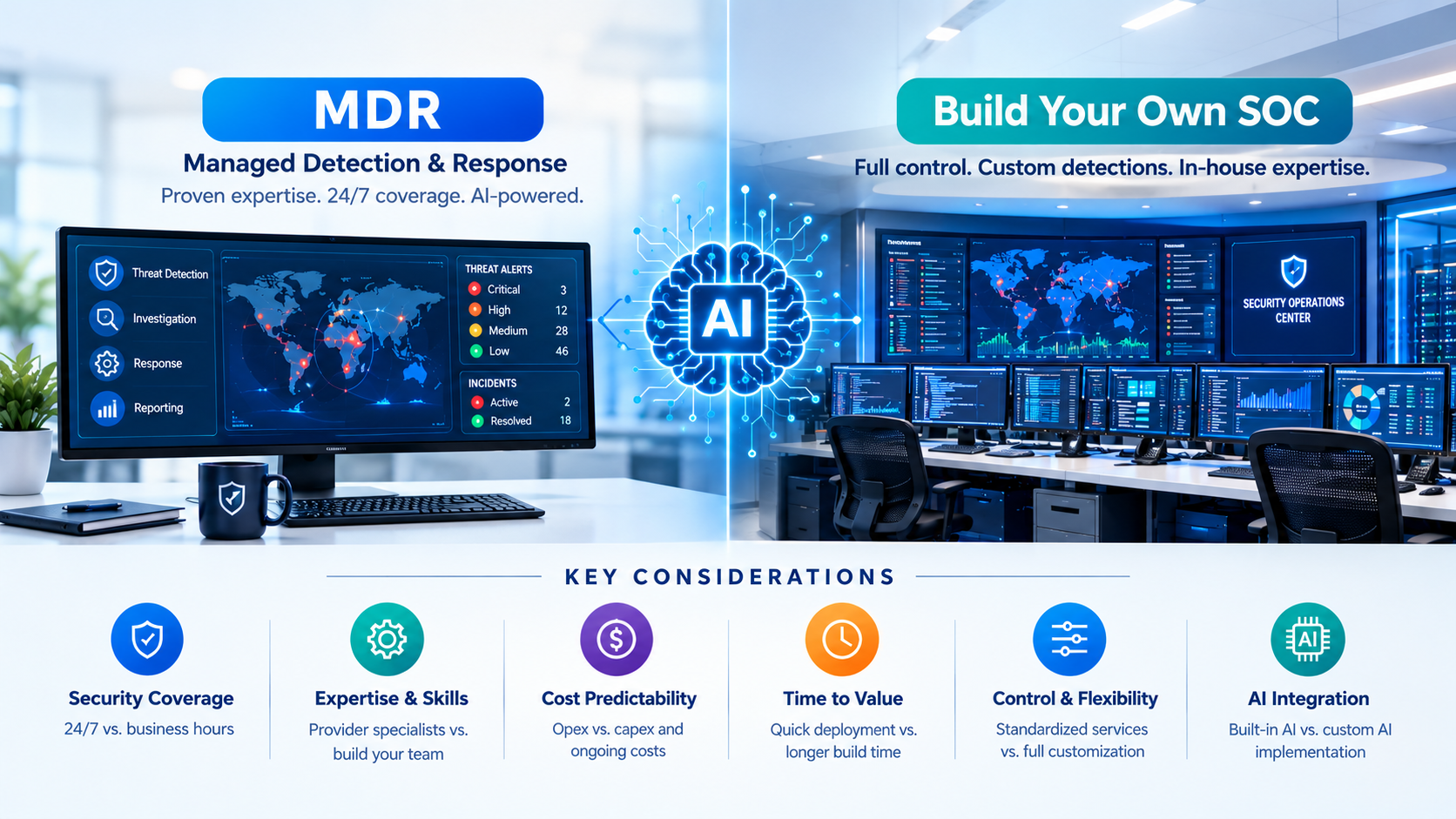
The decision to build an in-house Security Operations Center (SOC) or outsource security monitoring to a Managed Detection and Response (MDR) provider has always involved trade-offs between cost, control, expertise, and operational maturity.
Artificial intelligence (AI) is changing that equation.
AI-enabled security platforms can accelerate alert triage, summarize investigations, correlate security events, assist with threat hunting, and automate selected incident response activities. At the same time, attackers are using AI to improve phishing campaigns, automate reconnaissance, and accelerate aspects of their operations.
These developments raise an important question for security leaders:
Does AI make building an in-house SOC more affordable and practical, or does it make MDR services more valuable?
The answer depends on the organization's risk profile, regulatory obligations, technology environment, internal expertise, and ability to operationalize AI safely.
AI can reduce some of the effort required to run a SOC, but it does not eliminate the need for reliable telemetry, detection engineering, incident response expertise, governance, and 24/7 operational coverage.
This article examines MDR versus building an in-house SOC through a technical and strategic lens, including architecture, staffing, AI capabilities, detection engineering, cost considerations, and a hybrid operating model.
1. Understanding the Two Operating Models
Before comparing the options, it is important to distinguish between MDR and an internally operated SOC.
What is MDR?
Managed Detection and Response is a security service in which a third-party provider uses its technology, analysts, and operational processes to monitor an organization's environment, investigate threats, and support or perform incident response according to the service agreement.
Typical MDR capabilities include:
- 24/7 security monitoring
- Endpoint detection and response (EDR)
- Extended detection and response (XDR)
- Threat hunting
- Alert triage and investigation
- Detection content management
- Incident escalation and response
- Threat intelligence integration
- Security reporting
The exact capabilities vary by provider. Some MDR services include active containment, while others primarily investigate and escalate incidents.
What is an in-house SOC?
An in-house SOC is a security operations function managed by the organization itself. The organization owns the operating model and determines its technology stack, staffing, detection strategy, incident response procedures, and governance.
Typical responsibilities include:
- SIEM and security analytics operations
- Detection engineering
- Threat hunting
- Incident investigation and response
- Threat intelligence analysis
- Security automation
- Compliance monitoring
- Vulnerability and exposure coordination
- SOC performance reporting
An in-house SOC provides greater direct control, but the organization assumes responsibility for building and maintaining the required capabilities.
The fundamental difference
MDR transfers some operational responsibilities to a provider. An in-house SOC retains those responsibilities within the organization.
Neither model automatically guarantees better security. Effectiveness depends on detection quality, telemetry coverage, response authority, operational discipline, and the ability to adapt to changing threats.
2. How AI Is Changing the Economics of Security Operations
Historically, one of the largest barriers to building an in-house SOC has been the cost of recruiting, training, and retaining enough skilled analysts to provide continuous coverage.
AI changes parts of this cost structure by reducing the manual effort required for selected workflows.
AI-assisted alert triage
AI can enrich alerts with asset information, identity context, related events, and threat intelligence. It can help analysts distinguish routine activity from suspicious behavior.
Automated investigation support
AI can summarize timelines, explain suspicious process chains, suggest investigation queries, and assemble relevant evidence.
Security orchestration
AI can help coordinate predefined workflows across SIEM, EDR, identity, ticketing, and threat intelligence platforms.
Detection engineering assistance
AI can help draft detection queries, translate detection logic between supported languages, generate test cases, and explain rule behavior.
However, these capabilities should not be confused with autonomous security operations.
AI-generated conclusions can be incomplete or incorrect. Detection rules can contain logic errors. Automated workflows can take inappropriate actions when their inputs are unreliable.
Effective implementation therefore requires human oversight, testing, access controls, auditability, and defined escalation criteria.
The important economic question is not whether AI can replace analysts. It is how much validated operational work AI can remove without reducing security effectiveness.
3. MDR vs. In-House SOC: Technical Comparison
|
Capability |
MDR provider |
In-house SOC |
|
24/7 monitoring |
Typically included, subject to contract |
Must be staffed or supplemented |
|
Initial deployment |
Often faster if supported integrations exist |
Depends on architecture and implementation |
|
Detection engineering |
Provider-managed or shared |
Direct organizational control |
|
Environment-specific customization |
Depends on service flexibility |
High flexibility |
|
AI capabilities |
Depends on provider's platform and service |
Depends on internal tools and expertise |
|
Incident response |
Contract-defined; containment may be included |
Directly controlled by the organization |
|
Compliance evidence |
Provider reporting plus internal evidence management |
Tailored to internal control requirements |
|
Data and platform control |
Shared, contract-dependent |
Greater direct control |
|
Specialized internal knowledge |
May require internal escalation |
Can be developed internally |
|
Staffing responsibility |
Provider handles contracted operations |
Organization owns staffing and retention |
|
Operating cost |
Contract and usage dependent |
Staffing, technology, integration, and operating costs |
|
Accountability for business risk |
Remains with the organization |
Remains with the organization |
A key distinction is that outsourcing security monitoring does not outsource ultimate accountability for protecting the business.
The organization still needs to govern access, approve response authority, manage regulatory obligations, and ensure the provider meets agreed service levels.
4. The AI-Enabled MDR Model
MDR providers can use AI across a centralized service platform supporting multiple customers. This may allow them to distribute investments in detection technology, threat research, automation, and specialist personnel across their customer base.
Potential advantages include:
Economies of scale
A provider can spread the cost of its security platform and specialized teams across multiple customers. For organizations that cannot justify a full internal team, this can make mature operational capabilities more accessible.
Continuous operational coverage
An established MDR provider may already have analysts, escalation procedures, threat intelligence, and incident response workflows operating around the clock.
AI can help those teams handle investigations more consistently and prioritize cases more efficiently.
Cross-customer threat intelligence
Where contracts, privacy obligations, and technical architecture permit, providers may use appropriately aggregated threat observations to improve detections across their customer base.
This does not mean one customer's raw security data is automatically shared with another. Data handling must be governed by the provider's contractual and privacy controls.
Standardized detection operations
MDR providers can maintain detection content, test changes, and deploy updates through established operational processes.
However, standardization can also become a limitation if the service cannot accommodate an organization's specialized applications, business processes, or unusual threat scenarios.
The critical evaluation question: Does the MDR provider deliver measurable detection and response outcomes, or primarily provide a dashboard and a stream of escalated alerts?
5. The AI-Enabled In-House SOC Model
AI also makes an internal SOC more attractive for organizations with complex environments, established security teams, or strong requirements for operational control.
An AI-enabled in-house SOC can combine internal knowledge with automation to improve security operations.
Environment-specific detection engineering
Internal teams understand business applications, administrative workflows, critical assets, and acceptable operational behavior.
They can use that context to create detections that distinguish legitimate activity from genuine threats.
For example, a generic alert for PowerShell execution may generate excessive noise. A contextual detection that considers the initiating process, user privileges, command-line behavior, destination, and asset criticality may produce a more useful result.
Custom automation
An organization can develop workflows aligned with its own incident response procedures.
For example, a suspicious privileged login might trigger:
- Identity and device enrichment.
- Correlation with recent authentication events.
- Assessment of the affected account's privileges.
- Collection of relevant endpoint telemetry.
- Creation of an investigation case.
- Analyst review and escalation.
- Containment after the appropriate authorization.
AI can assist with enrichment and summarization, while deterministic controls govern sensitive actions.
Greater control over data and response
Internal SOCs can retain greater control over where security data is processed, how long it is retained, who can access it, and which response actions are authorized.
This can be important for regulated environments, sensitive intellectual property, critical infrastructure, and organizations with strict data residency requirements.
The hidden challenge
AI does not automatically solve the internal SOC's biggest problems.
An organization still needs to maintain:
- High-quality telemetry
- Detection engineering expertise
- SIEM and EDR integrations
- Incident response processes
- AI governance
- Platform maintenance
- Coverage for staff absences and turnover
- Operational resilience
A small team supported by AI may be more productive, but it is not necessarily capable of delivering uninterrupted 24/7 monitoring without additional coverage arrangements.
6. Architecture: Where AI Fits in Each Model
A practical AI-enabled SOC architecture should separate data collection, analytics, decision support, and response execution.
1. Telemetry Layer
Endpoints · Identity · Cloud · Network · Applications
2. Detection & Analytics
SIEM · EDR/XDR · UEBA · Correlation · Threat Intelligence
3. AI-Assisted Analysis
Triage · Enrichment · Investigation summaries · Query assistance
4. Decision & Response
Analyst review · Playbooks · Containment · Escalation
5. Governance & Validation
Audit logs · Access controls · Detection testing · Quality metrics
Illustrative architecture. MDR and in-house deployments can use similar logical layers; ownership and implementation differ.
In an MDR model, the provider typically operates much of the analytics and investigation stack, while the customer retains responsibility for business context, governance, and agreed response decisions.
In an in-house model, the organization operates and maintains the stack directly.
In either case, AI should not be allowed to bypass authorization, logging, or response controls.
7. Detection Engineering: The Deciding Factor
AI-assisted alert investigation receives considerable attention, but detection engineering is equally important when comparing MDR with an internal SOC.
A SOC is only as effective as its ability to observe relevant activity and identify malicious behavior.
AI can help create detection content, but it cannot compensate for missing telemetry or an incorrectly defined threat scenario.
A mature detection engineering lifecycle should include:
- Threat modeling: Identify adversary behaviors relevant to the organization.
- Telemetry assessment: Confirm the necessary events are collected.
- Rule development: Create behavioral detections and correlation logic.
- ATT&CK mapping: Associate detections with relevant MITRE ATT&CK techniques.
- Testing: Validate expected matches and known benign activity.
- Deployment: Release changes through controlled processes.
- Monitoring: Measure alert quality and investigate failures.
- Continuous improvement: Tune detections as threats and environments change.
An MDR provider may bring mature processes and broad threat expertise. An internal SOC may bring deeper business-specific knowledge and greater customization.
The strongest approach depends on which capabilities the organization already possesses and which it needs to acquire.
How to evaluate an MDR provider's detection capability
Ask the provider:
- Can detections be customized for our environment?
- How are new rules tested before deployment?
- How are false positives measured and reduced?
- Are ATT&CK mappings available?
- Can we review detection coverage gaps?
- How frequently are critical detections validated?
- What telemetry is required for each service?
- How are detection changes documented?
Do not accept a coverage percentage without understanding how coverage is defined. A mapped rule is not equivalent to a validated, high-fidelity detection.
8. Cost Comparison: Total Cost of Ownership
Comparing an MDR contract with the cost of hiring a few SOC analysts is misleading.
An internal SOC requires a broader investment than salaries alone.
In-house SOC costs
Typical cost categories include:
- Analyst, engineer, and manager compensation
- Recruitment and training
- SIEM licensing and ingestion
- EDR/XDR licensing
- Cloud infrastructure and storage
- Threat intelligence
- SOAR and automation
- AI model usage and infrastructure
- Platform integration
- Detection validation
- On-call and shift coverage
- Incident response retainers
- Business continuity and backup coverage
AI may reduce the amount of repetitive analyst work, but the resulting savings depend on workload, licensing, integration costs, and the degree of automation that can be safely implemented.
MDR costs
Typical cost categories include:
- Contracted service fees
- Endpoint or asset-based pricing
- Data ingestion or retention charges, where applicable
- Premium response services
- Additional integrations
- Out-of-scope investigation fees
- Internal personnel required to manage the provider
- Costs associated with contract transitions or exit
Pricing models vary significantly. Some providers bundle technology and services, while others charge separately for particular capabilities.
A practical comparison framework
|
Cost consideration |
In-house SOC |
MDR |
|
Initial setup |
Potentially high |
Often lower, but integration costs remain |
|
Staffing |
Direct and ongoing |
Primarily included for contracted functions |
|
Technology |
Organization procures or operates it |
Bundled or separately charged |
|
Custom engineering |
Internal investment |
May incur additional service costs |
|
Scaling |
Requires staffing and capacity planning |
Often easier within service boundaries |
|
Internal governance |
Required |
Still required |
|
Provider management |
Not applicable in the same way |
Requires ongoing oversight |
|
Exit and transition |
Internal continuity planning |
Data portability and transition planning |
The correct financial comparison should model at least three years of total cost of ownership and include realistic staffing, technology, growth, and response requirements.
9. Risk, Compliance, and Data Governance
AI adds a new dimension to the decision.
Organizations need to understand how security data is handled by both their security platforms and any external provider.
Key questions include:
- Where is telemetry processed and stored?
- Can customer data be used to train shared models?
- What are the data retention and deletion terms?
- Which subcontractors or model providers can access data?
- How are model inputs and outputs protected?
- Can AI-generated recommendations be audited?
- What permissions does an AI agent possess?
- Can an AI workflow isolate endpoints or disable accounts?
- How are mistakes detected, reversed, and investigated?
For regulated organizations, these questions should be addressed during procurement and architecture design—not after deployment.
The organization should also retain appropriate evidence of monitoring, investigation, and response activities.
Frameworks such as NIST Cybersecurity Framework 2.0, NIST AI Risk Management Framework, and applicable regulatory controls can help structure governance, depending on the organization's obligations.
AI should be treated as part of the security architecture and risk model, not as an isolated productivity feature.
10. When Should You Choose MDR, an In-House SOC, or a Hybrid Model?
There is no universal answer. The appropriate model depends on the capabilities the organization needs, the resources available, and the consequences of a security failure.
MDR-first
Best suited to: Organizations with limited security staffing or a need to establish monitoring quickly.
Consider MDR when:
- 24/7 coverage is difficult to staff internally.
- The organization lacks mature detection engineering.
- Predictable service costs are desirable.
- Standardized monitoring and response meet business requirements.
Watch out for: Limited customization, unclear response authority, and dependence on the provider's tooling and processes.
In-house SOC
Best suited to: Organizations with substantial internal expertise, complex infrastructure, or specialized operational requirements.
Consider an internal SOC when:
- Detection logic requires extensive customization.
- Deep integration with business operations is essential.
- Internal control over data and investigations is a priority.
- The organization can sustain staffing, engineering, and platform costs.
Watch out for: Understaffing, analyst turnover, technology sprawl, and overestimating what AI can automate.
Hybrid SOC
Best suited to: Organizations that need external operational coverage but want to retain internal security strategy and oversight.
A common division of responsibilities is:
- MDR provides continuous monitoring and initial investigation.
- Internal security engineers own critical detection use cases.
- The organization retains incident command and risk decisions.
- AI automates approved enrichment and response workflows.
- Joint reviews measure coverage, service quality, and improvement.
Watch out for: Gaps between provider and internal responsibilities, duplicated tools, and unclear incident ownership.
For many organizations, a hybrid approach is worth evaluating first. It can provide access to mature monitoring capabilities while preserving internal ownership of business risk, detection priorities, and incident decisions.
It is not automatically cheaper or better, however. The operating model must clearly define responsibilities and avoid duplicating expensive capabilities.
11. A Practical Decision Framework
Security leaders can evaluate the options using a structured assessment.

Regardless of the model selected, the organization should establish clear incident escalation criteria, measurable service levels, detection validation procedures, and defined authority for disruptive response actions.
12. What to Measure in an AI-Enabled SOC
A common mistake is measuring AI adoption instead of security outcomes.
The number of AI agents deployed or alerts automatically summarized tells leadership little about whether the organization is safer.
Measure operational effectiveness instead.
|
Metric |
What it tells you |
|
Mean Time to Detect (MTTD) |
How quickly relevant threats are identified |
|
Mean Time to Respond (MTTR) |
How quickly incidents are contained or resolved, using a clearly defined measurement |
|
Detection validation rate |
Whether critical detections are tested successfully |
|
False positive rate |
How much alert noise is generated |
|
Investigation time |
Analyst effort required to reach a defensible conclusion |
|
Telemetry coverage |
Whether critical assets generate required data |
|
Automation success rate |
Whether automated workflows complete correctly |
|
Escalation accuracy |
Whether incidents reach the right responders |
|
Containment time |
How quickly authorized containment occurs |
|
Cost per investigated incident |
Operational cost relative to investigation workload |
AI-related measurements should also include the rate of incorrect recommendations, human override frequency, unauthorized-action prevention, and quality assurance results.
These metrics should be compared before and after implementation, with workload and threat complexity taken into account. Avoid attributing every improvement to AI when changes in telemetry, staffing, or detection logic may also contribute.
Conclusion: AI Changes the Build-versus-Buy Equation, but Not the Need for Accountability
AI is reshaping the economics of security operations by accelerating routine analysis, supporting detection engineering, and enabling more sophisticated automation.
For MDR providers, AI can improve service efficiency and make mature monitoring capabilities accessible to more organizations.
For internal SOCs, AI can increase analyst productivity, strengthen environment-specific detections, and reduce some operational bottlenecks.
But AI does not eliminate the need for quality telemetry, skilled security professionals, tested detection logic, reliable incident response, and strong governance.
The right decision is not simply whether to build or buy.
It is deciding which security capabilities must remain under direct organizational control, which can be delivered more effectively by a provider, and where AI can safely improve performance.
For many organizations, the most effective model will combine external operational expertise with internal ownership of risk, detection priorities, and incident command.
The winning SOC will not necessarily be the one with the most analysts, the most AI agents, or the largest technology budget.
It will be the one that can consistently detect relevant threats, make sound decisions, respond within acceptable timeframes, and demonstrate measurable security outcomes.
The strategic question for CISOs is no longer just "Should we build or buy a SOC?"
It is:
"How do we design an AI-enabled security operations model that delivers the right balance of detection effectiveness, operational control, resilience, and cost?"
That is the decision framework that matters in the era of AI.
Phelix Oluoch
Founder, PhelixCyber
W: PhelixCyber.com
